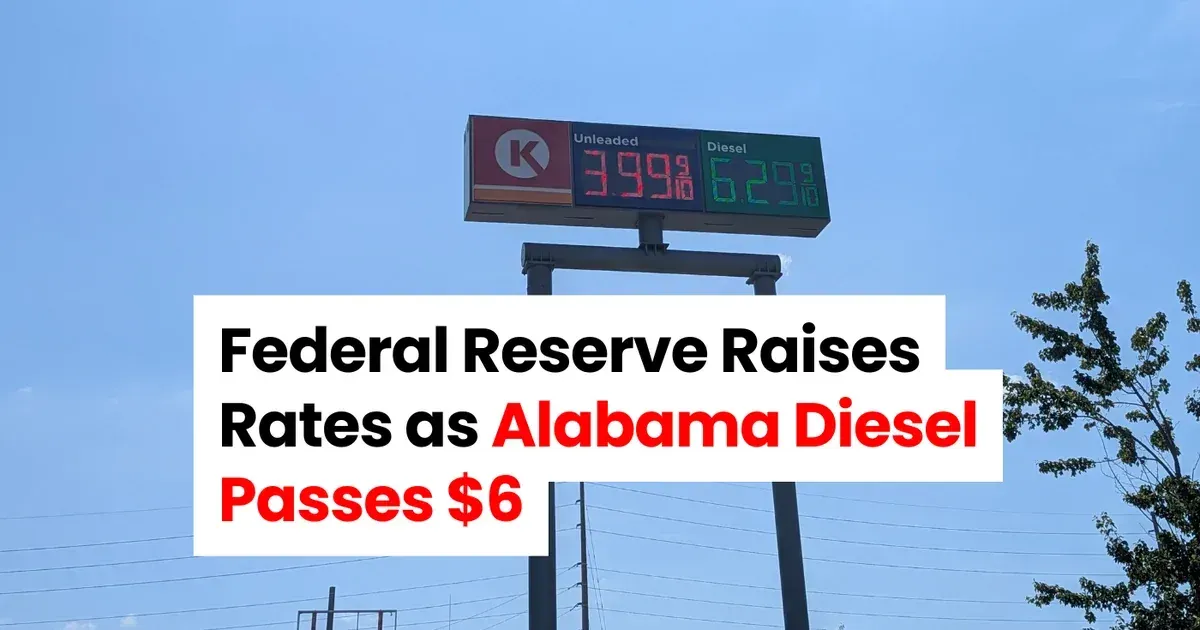
The Federal Reserve raised its benchmark interest rate a quarter point on September 16, 2026, to a target range of 3.75% to 4%, its first increase since 2023, as Alabama drivers paid $3.99 a gallon for regular gasoline and $6.10 for diesel.
The Federal Reserve rate hike reaches Alabama through two channels at once: the price of credit and the price of fuel. Eight of the largest U.S. banks raised their prime lending rate to 7% from 6.75%, Reuters reported. Gasoline prices nationally rose 27.4% over the 12 months ending in August, according to the U.S. Bureau of Labor Statistics.
Key Details
- Rate decision: The Federal Open Market Committee raised the federal funds target range to 3.75%–4% on September 16, 2026, by a 12-0 vote — its first increase since 2023.
- Prime rate: Eight major U.S. banks raised prime to 7% from 6.75%, effective September 17, 2026, Reuters reported.
- Alabama fuel: AAA put Alabama at $3.99 a gallon for regular gasoline and $6.10 for diesel on September 17, 2026, against $2.80 and $3.44 a year earlier.
- Inflation: The consumer price index rose 3.4% over the 12 months ending August 2026, with energy up 16.3% and gasoline up 27.4%, the U.S. Bureau of Labor Statistics reported.
- Mortgages: Bankrate's 30-year fixed average was 6.97% on September 16, 2026, against 6.30% a year earlier.
Why the Federal Reserve Raised Rates
The Federal Open Market Committee said in its September 16 statement that "inflation remains elevated" and that "today's policy action will support a timelier return to the Committee's 2 percent goal." The committee also said job gains "have kept pace with the workforce" and that the unemployment rate "has changed little."
Federal Reserve Chair Kevin Warsh said at the post-meeting press conference that "inflation is too high and has been for too long" and that the central bank "will deliver on the price stability objective," according to Kiplinger's live coverage. Warsh declined to prejudge future decisions.
The Federal Reserve's own projections point toward further tightening. A majority of FOMC participants projected at least one additional quarter-point increase in 2026, NerdWallet reported. The committee's remaining 2026 meetings are scheduled for October 27–28 and December 8–9.
How Much Have Alabama Fuel Prices Risen?
Alabama's average price for regular gasoline was $3.99 a gallon on September 17, 2026, and diesel averaged $6.10, according to AAA. A year earlier, AAA put the state averages at $2.80 for regular and $3.44 for diesel — increases of roughly $1.19 and $2.66 a gallon.
Diesel has moved faster than gasoline in Alabama over the past month. AAA's Alabama diesel average rose about 94 cents from a month earlier, against about 39 cents for regular gasoline. The national on-highway diesel average was $6.285 a gallon in the week ending September 14, 2026, the U.S. Energy Information Administration reported.
Alabama pump prices remain below the national figures. AAA's national average for regular gasoline was $4.37 on September 16, 2026, about 37 cents above Alabama's.
Why Diesel Is Rising Faster Than Gasoline
The diesel increase traces to refining capacity rather than crude oil supply, according to energy consultancy RBN Energy. RBN Energy reported that the U.S. Gulf Coast diesel crack spread against West Texas Intermediate crude passed $100 a barrel on August 17, 2026, which it described as the first time that level had been reached.
RBN Energy attributed the shortfall to damage at Middle Eastern refineries during the Iran conflict, disruption around the Strait of Hormuz, Ukrainian drone strikes on Russian refining and export facilities, and unreplaced refinery closures during the COVID years. U.S. distillate inventories fell to just above 103 million barrels as of August 21, 2026, which RBN Energy called the lowest August level since 1951.
Diesel costs reach shelf prices through freight rates. Jim Wall, president of 256 Trucking, said in March 2026 remarks that "whenever diesel goes up, especially when it goes up as high as it did in such a short timeframe, we have to pass that kind of cost along to our customers." Alabama's diesel average was $4.98 a gallon then.
Alabama fleets are adjusting. Tiffany Russell, fleet manager for the City of Gadsden, told WBRC on September 14, 2026 that the city negotiated a rate with a local fuel distributor and cut vehicle idle time. Jerry Raymond, an independent truck driver from Birmingham, told the station, "We'll get your freight to you. You may pay more, but we'll get your freight to you."
What Higher Rates Mean for Alabama Borrowers
The prime rate is the reference point for most variable-rate small business loans, credit cards and home equity lines of credit. JPMorgan, Bank of America, Citigroup, Wells Fargo, KeyCorp, Huntington Bancshares, Fifth Third Bancorp and Truist Financial raised prime to 7% from 6.75% effective Thursday, September 17, 2026, Reuters reported.
Mortgage rates had already risen ahead of the decision. Bankrate put the 30-year fixed average at 6.97% on September 16, 2026, and the 15-year fixed at 6.31%, against a 30-year average of 6.30% a year earlier and a 2026 low of 6.09%.
Lisa Sturtevant, chief economist at Bright MLS, said the increase "all but guarantees that mortgage rates will remain stuck at or above the 7% threshold, which creates a psychological and financial barrier," according to Bankrate. Savers see the other side: NerdWallet reported banks may raise yields on savings accounts and certificates of deposit.
What This Means for North Alabama
The Federal Open Market Committee's September 16 statement did not mention Alabama, and neither the statement nor Warsh's remarks identified effects in any individual state or metro area. The closest regional measure is the South-region consumer price index, which rose 3.1% over the 12 months ending August 2026, with energy up 15.8%, gasoline up 28.5%, electricity up 2.5% and food up 2.3%, the U.S. Bureau of Labor Statistics reported.
Electricity has not moved the way motor fuel has in the Tennessee Valley. The Tennessee Valley Authority, which supplies Huntsville Utilities, listed its total monthly fuel cost at 2.404 cents per kilowatt-hour for September 2026. Huntsville Utilities has described the fuel cost adjustment as the portion of the electric rate that changes each month with the cost of fuel used to generate power.
Regional power demand is growing at the same time. Google said it would invest $1.5 billion across 2026 and 2027 to expand its Jackson County data center campus in northeast Alabama, on the former TVA Widows Creek site, The Huntsville Commerce Report reported.
Household budgets in Alabama also carry a tax change that runs the other way. Alabama reduced the state sales and use tax on food to 2% from 3% on September 1, 2025, and suspended the state portion entirely from May 1 through June 30, 2026 under Act 2026-604, according to the Alabama Department of Revenue. City and county taxes on food were not affected by the suspension.
The regional labor market has stayed tight through the price increases. The unemployment rate for the Huntsville metropolitan statistical area was 2.8% in July 2026, according to U.S. Bureau of Labor Statistics data published by the St. Louis Fed.
Related coverage: Huntsville business news · Alabama business news · Nordstrom Rack's first Huntsville location
Frequently Asked Questions
How much did the Federal Reserve raise interest rates in September 2026?
The Federal Reserve raised the federal funds target range by a quarter point, to 3.75% to 4%, on September 16, 2026. The Federal Open Market Committee approved the increase 12-0 and said it would support a timelier return to its 2% inflation goal.
When did the Federal Reserve last raise rates before September 2026?
The September 16, 2026 increase was the Federal Reserve's first rate hike since 2023. The Federal Open Market Committee said inflation remains elevated, and Chair Kevin Warsh said at the press conference that inflation "is too high and has been for too long."
What are gas and diesel prices in Alabama right now?
AAA put Alabama's average at $3.99 a gallon for regular gasoline and $6.10 a gallon for diesel on September 17, 2026. A year earlier, AAA listed Alabama averages of $2.80 for regular and $3.44 for diesel, increases of about $1.19 and $2.66 a gallon respectively.
Why is diesel rising faster than gasoline in 2026?
Energy consultancy RBN Energy attributes the diesel increase to global refining capacity rather than crude supply, citing damage to Middle Eastern refineries, Ukrainian strikes on Russian refining facilities and unreplaced closures. RBN Energy reported U.S. distillate inventories at just above 103 million barrels as of August 21, 2026.
Will the Federal Reserve raise rates again in 2026?
A majority of Federal Open Market Committee participants projected at least one more quarter-point increase in 2026, NerdWallet reported. Chair Kevin Warsh declined to prejudge future decisions. The committee's remaining scheduled meetings for 2026 are October 27–28 and December 8–9.
The Federal Open Market Committee's next scheduled meeting is October 27–28, 2026, with a final 2026 meeting set for December 8–9. AAA updates its Alabama fuel averages daily, and the U.S. Energy Information Administration publishes retail fuel prices weekly.
Author
Sign up for Huntsville Commerce Report - Huntsville, AL Business News newsletters.
Stay up to date with curated collection of our top stories.