HUNTSVILLE, Ala. – A graduate student at The University of Alabama in Huntsville (UAH) has led an international research team in identifying the fastest gamma-ray burst (GRB) ever recorded, marking a significant milestone for the university’s College of Science and Huntsville’s aerospace research sector.
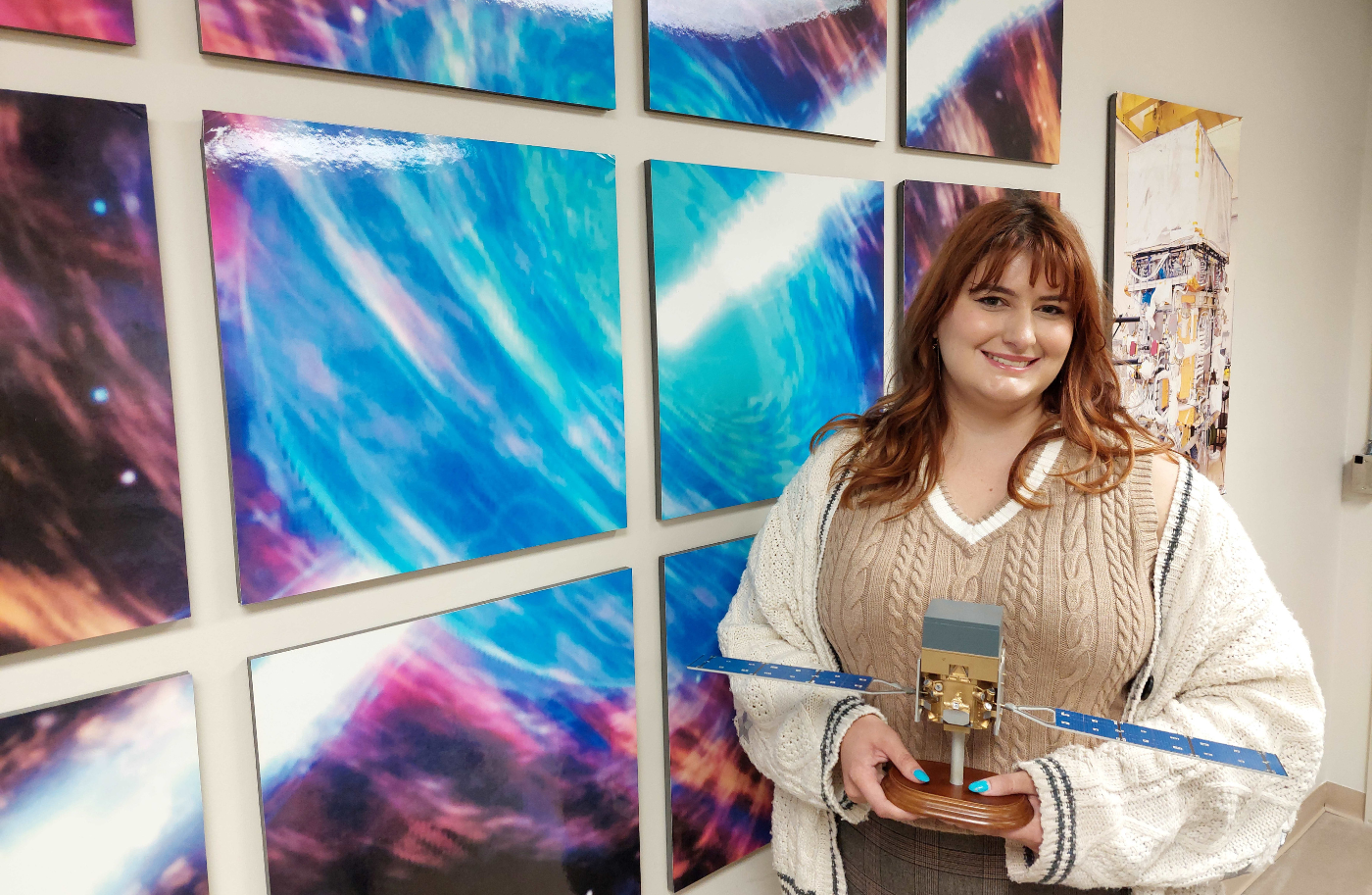
Sarah Dalessi, a fifth-year doctoral student, served as the lead author on a paper detailing the discovery of GRB 230307A. The findings, which confirm the burst's jet traveled at velocities previously unmeasured in astrophysical history, underscore the critical role Huntsville institutions play in global space science and data analysis.
Record-Breaking Cosmic Event
Unprecedented Velocity and Brightness
The event, categorized as GRB 230307A, is an ultrarelativistic gamma-ray burst distinguished by its extreme speed. According to the research team, the velocity of the GRB’s jet—a focused beam of high-energy particles—reached within 99.99998 percent of the speed of light (approximately 186,000 miles per second).
Dr. Peter Veres, an assistant professor at the UAH Center for Space Plasma and Aeronomic Research (CSPAR) and co-author of the study, highlighted the statistical significance of the event.
“The Lorentz factor is the measure of speed of the jet here, and 1,600 is the highest we ever measured,” said Dr. Veres.
For context, typical gamma-ray burst jets exhibit Lorentz factors ranging from 100 to 1,000, with an average around 300. The magnitude of this discovery provides researchers with new data points regarding the energy, luminosity, and environmental conditions surrounding these massive cosmic events. Additionally, GRB 230307A stands as the second-brightest gamma-ray burst observed in more than 50 years of data collection.
Collaborative Success in Huntsville
From Data to Discovery
The discovery highlights the successful integration of academic research and federal aerospace operations in Huntsville. Dalessi’s work was conducted in collaboration with the Gamma-ray Burst Monitor (GBM) team, a partnership between NASA and the National Space Science and Technology Center (NSSTC) at UAH. The NSSTC serves as the operations center for the project, working alongside the Max Planck Institute for Extraterrestrial Physics in Germany.
Dalessi, who serves as a "Burst Advocate" for the team, was responsible for processing incoming triggers from the Fermi Gamma-ray Space Telescope when the event occurred.
“It was during one of my shifts when I got the trigger notification for GRB 230307A, and right away, I knew that this was an extraordinarily bright event,” Dalessi stated. “To be a part of such a unique discovery is not something I ever planned or dreamed of.”
The proximity to NASA’s Marshall Space Flight Center remains a key economic and academic driver for the region, attracting top-tier talent to local institutions. Dalessi cited the opportunity to work directly with NASA collaborators as a primary factor in her decision to attend UAH.
Scientific Implications: The "Cosmic Kitchen"
Heavy Element Formation
Beyond its speed, the research into GRB 230307A offers vital insights into the formation of heavy elements. The burst was accompanied by a "kilonova"—an optical signal resulting from the merger of neutron stars. These mergers are theorized to be the primary source of the universe's heaviest elements.
“The mergers of compact binary objects, such as those involving two neutron stars, serve as almost a cosmic kitchen for heavy elements,” Dalessi explained. “During the merger, there is an abundance of neutron-rich matter that is expelled, and then is decompressed in space and can generate rare heavy elements such as gold and platinum.”
Follow-up observations conducted by researchers in the United Kingdom and the Netherlands, utilizing NASA's James Webb Space Telescope, confirmed the presence of tellurium, a rare heavy element, within the kilonova remnant.
This discovery not only advances the understanding of high-energy astrophysics but also reinforces Huntsville's status as a central hub for space exploration and scientific inquiry.
You can read more at https://www.uah.edu/news/items/uah-student-researcher-leads-discovery-fastest-gamma-ray-burst-ever-recorded
This article was published in a news partnership with UAH.
Author
Sign up for Huntsville Commerce Report - Huntsville, AL Business News newsletters.
Stay up to date with curated collection of our top stories.