
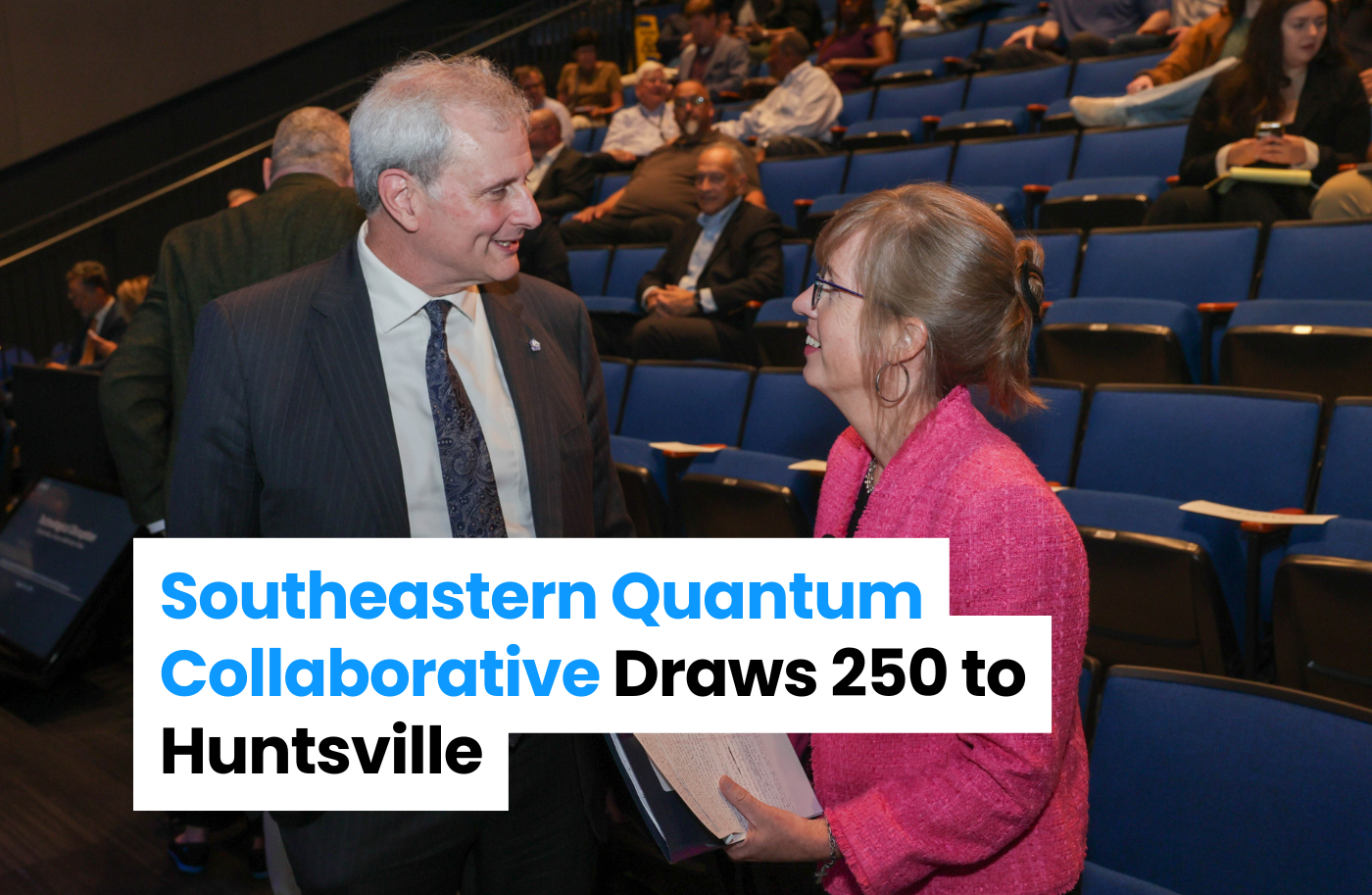
The Southeastern Quantum Collaborative drew about 250 academic, industry and government leaders to the University of Alabama in Huntsville for its inaugural Quantum Colloquium, the university said in an announcement issued September 11, 2026.
The Southeastern Quantum Collaborative, known as the SQC, is a regional consortium run through the UAH College of Science to speed up the development and practical use of quantum information science across the Southeast. The colloquium logged 273 registrations, according to UAH, and put IBM, IonQ, D-Wave, Leidos and Huntsville-based Davidson Technologies in the same room as U.S. Space Command and Oak Ridge National Laboratory.
Key Details
- Attendance: about 250 people attended, drawn from 273 registrations, according to UAH.
- Host and venue: the University of Alabama in Huntsville, at the Charger Union Theater on the UAH campus.
- Organizer: the Southeastern Quantum Collaborative, a regional consortium run through the UAH College of Science and launched January 1, 2026.
- Format: three panels covering workforce development, research and development, and government focus and needs, each moderated by an SQC member.
- Participants: seven companies, three government organizations and seven universities, including IBM, IonQ, D-Wave, Davidson Technologies and U.S. Space Command.
- Announced by: the University of Alabama in Huntsville, September 11, 2026.
Who Attended the Southeastern Quantum Collaborative Colloquium
Participating organizations at the Southeastern Quantum Collaborative colloquium included IBM, IonQ, D-Wave, Leidos, COLSA, ECS and Davidson Technologies, along with the DEVCOM Aviation & Missile Center, U.S. Space Command and Oak Ridge National Laboratory, according to the UAH announcement.
Academic participants included UAH, The University of Alabama, Alabama A&M University, Vanderbilt University, Middle Tennessee State University, Florida Atlantic University and the University of Tennessee. UAH is part of the University of Alabama System.
Ray Vaughn, program director for the SQC and former vice president for research and economic development at UAH, put the turnout in statewide terms. "We had 273 registrations for the colloquium, and our audience included about 250 attendees," Vaughn said. "To the best of my knowledge, it was the largest gathering of interest in quantum science ever in Alabama."
Participation reached past the Southeast. Panelists included a chief executive from Brooklyn, New York, industry representatives from the Midwest, academic representatives from Florida and Tennessee, and government representatives from New York and Colorado, according to UAH.
What the Three Colloquium Panels Covered
The colloquium ran three panels, which Vaughn said the SQC used to map the field's near-term problems: "one on the need for workforce development, one on R&D efforts and one on government focus and needs."
The workforce sessions examined ways to scale regional quantum information science talent pipelines and specialized curricula, according to UAH. The research sessions covered advances in quantum hardware, algorithmic optimization and scalable quantum architectures. The government sessions addressed dual-use quantum technologies, post-quantum cybersecurity and national security priorities.
Vaughn separated the parts of quantum science that are working now from the parts that are not. "Of particular interest most recently is quantum sensing and quantum networking," Vaughn said. "Quantum computing is in its infancy, although developing quickly, as is quantum cryptography."
Vaughn said the event also produced recruiting leads, telling UAH the SQC "developed several new prospective members." UAH did not name them or give a number.
How the Southeastern Quantum Collaborative Formed
The Southeastern Quantum Collaborative launched January 1, 2026 under the UAH College of Science. UAH's launch announcement named IBM, Davidson Technologies and Alabama A&M University among the organizations forming the consortium, with IonQ, Leidos, Oak Ridge Associated Universities and the University of Tennessee at Chattanooga committed as inaugural members. D-Wave Quantum Inc. announced on February 19, 2026 that it had joined as an inaugural member.
Rainer Steinwandt, dean of the UAH College of Science, has tied the consortium's case to the region's defense base. "The SQC aims to leverage the region's unique concentration of cleared defense infrastructure, advanced missile defense expertise and strong base of prime contractors to accelerate the transition of quantum information science and technology into field-ready capabilities," Steinwandt said. "The collaborative's goal is to transform the Southeastern United States into an applied quantum science leader."
Huntsville already houses operating quantum hardware. Davidson Technologies completed installation of a D-Wave Advantage2 annealing quantum computer at its Huntsville headquarters in April 2025, which D-Wave described as Alabama's first on-site annealing quantum computer and the first Advantage2 deployed outside D-Wave's own facilities.
UAH has built a run of industry partnerships alongside its research programs. Microsoft and Palo Alto Networks have each joined UAH's Invention to Innovation Center as corporate partners, and the university hosted the inaugural Army Best Drone Warfighter Competition on its campus. The SQC carries that pattern into quantum information science, a field that has not previously appeared in Huntsville technology news coverage of the region's research base.
UAH's July 2026 advance announcement scheduled the colloquium for August 10, 2026 and listed Whitney Mason of the Defense Advanced Research Projects Agency as keynote speaker. The September 11 announcement did not state the date the event was held.
What This Means for North Alabama
The colloquium produced the clearest public accounting so far of who is taking part in the SQC, and the participant list is the piece with regional consequence. Davidson Technologies and COLSA are both headquartered in Huntsville, and the DEVCOM Aviation & Missile Center is based at Redstone Arsenal.
U.S. Space Command, another listed participant, is relocating its headquarters to Redstone Arsenal from Colorado Springs, Colorado, and took operational control of its first Redstone facility on April 29, 2026, according to the command. The workforce panel places UAH and Alabama A&M University in the position of supplying that talent pipeline.
UAH did not disclose the SQC's total membership, its budget, its funding sources or any dollar figure attached to the consortium. Vaughn said ideas under consideration for the next phase include additional educational gatherings, scholarships to promote the study of quantum science and sponsorship opportunities. No dates, amounts or award criteria were attached to those items.
Frequently Asked Questions
What is the Southeastern Quantum Collaborative?
The Southeastern Quantum Collaborative is a regional consortium run through the College of Science at the University of Alabama in Huntsville. Launched January 1, 2026, the SQC exists to speed up the development and practical use of quantum information science across the Southeast through academic, industry and government participation.
How many people attended the SQC's first Quantum Colloquium?
About 250 people attended the inaugural Southeastern Quantum Collaborative colloquium at UAH's Charger Union Theater, drawn from 273 registrations, according to a UAH announcement issued September 11, 2026. Program director Ray Vaughn said it was, to his knowledge, the largest quantum science gathering held in Alabama.
Which companies and agencies took part in the colloquium?
Participants in the Southeastern Quantum Collaborative colloquium included IBM, IonQ, D-Wave, Leidos, COLSA, ECS, Davidson Technologies, the DEVCOM Aviation & Missile Center, U.S. Space Command and Oak Ridge National Laboratory, according to UAH. Seven universities took part, among them Alabama A&M University and Vanderbilt University.
Why is Huntsville a center for quantum work?
UAH College of Science Dean Rainer Steinwandt attributes the Southeastern Quantum Collaborative's regional case to Huntsville's concentration of cleared defense infrastructure, missile defense expertise and prime contractors. Davidson Technologies installed a D-Wave Advantage2 at its Huntsville headquarters in April 2025, which D-Wave called Alabama's first on-site annealing quantum computer.
What happens next for the Southeastern Quantum Collaborative?
Ray Vaughn, program director for the Southeastern Quantum Collaborative, said ideas under consideration include additional educational gatherings, scholarships to promote the study of quantum science and sponsorship opportunities. UAH announced no dates, dollar amounts or second colloquium on September 11, 2026.
The Southeastern Quantum Collaborative has not announced a date for a second colloquium or released an updated membership roster. The consortium is the first quantum-specific organization to appear in The Huntsville Commerce Report's Huntsville business news coverage, and inquiries about it go to program director Ray Vaughn at the UAH College of Science.
Author
Sign up for Huntsville Commerce Report - Huntsville, AL Business News newsletters.
Stay up to date with curated collection of our top stories.